Chainpoint sessions
As a terminal, make several dependent reads and paginate results from one selected ledger state, even while the provider follows new blocks. If that state cannot be served, receive a named refusal rather than a silently newer answer.
Find a usable chainpoint
The terminal first intersects accepted anchor publications with the ledger provider's advertised retained views and history coverage. It selects one network, chainpoint and compatible commitment scheme that satisfy its action policy, then asks the provider to acquire that exact view. The anchor continues publishing independently; it does not negotiate sessions.
Availability can change between discovery and acquisition. Acquisition either confirms the selected view and lease or explicitly refuses it. With no usable overlap, the terminal waits, changes provider or explicitly selects another acceptable chainpoint. It never combines answers from different points or searches combinations of already-fetched data. The discovery wire format remains open; this handshake is required. See the proof-composition sequence.
Session contract
Use chainpoint throughout Lockness. This corresponds to Cardano API's ChainPoint: either genesis or a slot number paired with a block-header hash. The network is separate context and must also be bound by the protocol. A slot number alone does not identify a chainpoint across competing branches.
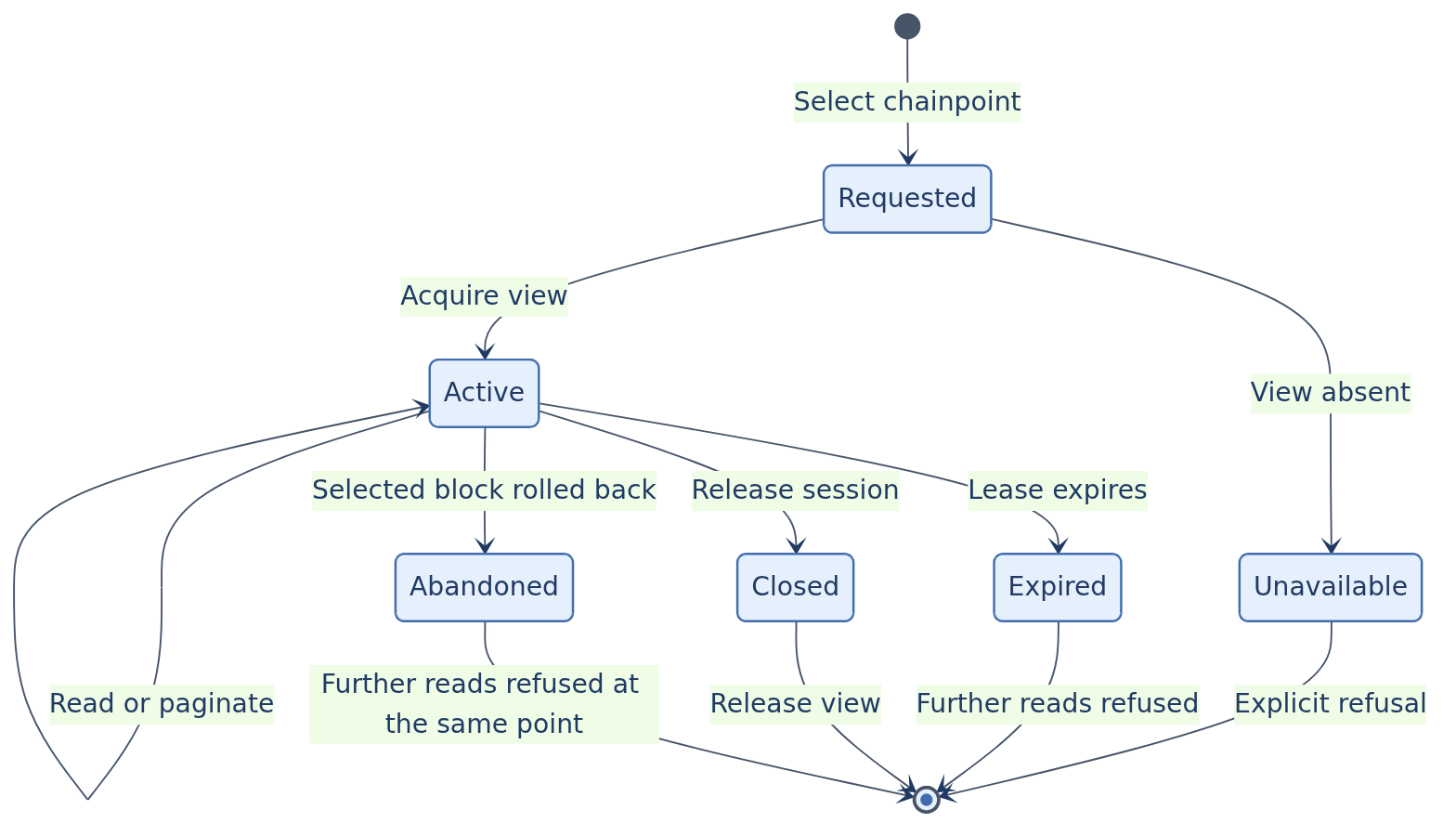
A session token binds reads to the network, selected chainpoint and a retained view; it is not a source of trust. A chainpoint names a chain position, a view exposes state at that position, and a session retains access under a lease. The terminal verifies results against its separately accepted commitment. Different providers may issue different tokens for the same chainpoint. Whether sessions can be acquired at genesis remains a service-contract decision.
Open full size · Mermaid source
Retention and lease limits are not yet fixed. The design must bound resource use without evicting an active view contrary to its advertised contract. A rollback does not turn a block hash into a different block. When the selected block leaves the canonical branch of the terminal's chain view, the session becomes abandoned. Every further read is refused at the session's own chainpoint, never answered from another point, and an abandoned session has no outgoing transition. Only an active session is abandoned; an expired or closed session already refuses its reads. Under the continued-ancestry hypothesis, with the consensus model admitting the present view, a point that is not canonical in that view never carries an external effect. Transaction construction does not read the chain, so a claim verified while the point was canonical may still be used to build a transaction, which Cardano revalidates against its actual ledger state; no new material is read from the abandoned session. No automatic chainpoint substitution is allowed.
Storage separation
Open full size · Mermaid source
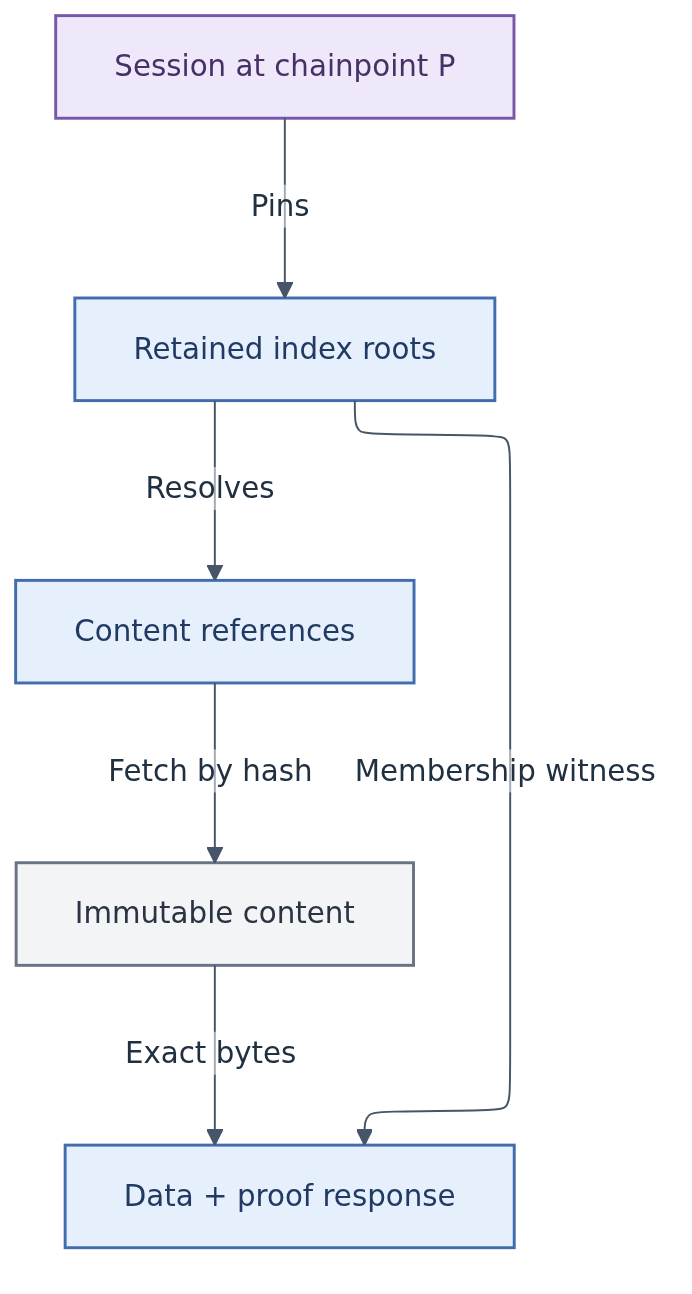
Immutable content survives rollback. Chain-index membership and branch status determine which content belongs to the selected ledger state. Storing an object is not evidence that it is live or canonical.
Retained views may use persistent index nodes, shared snapshots, or an isolated overlay reconstructed using rollback information. The mechanism has not been chosen. A read-only RocksDB snapshot is not itself a writable rollback target, and snapshot handles do not survive database restarts. A restart-surviving view needs a durable design, for example versioned nodes, persisted rollback overlays or separately retained database checkpoints. A RocksDB checkpoint is a storage mechanism, distinct from a Cardano chainpoint. Storage growth, write amplification, historical-read latency and session concurrency require measurement before choosing an implementation.
History coverage before costing
Choose archive coverage before sizing or committing to ledger-provider operating costs. Retaining every transaction and selecting transactions by generic asset or address filters are different service offers; neither is assumed here. Both preserve complete transaction CBOR for the transactions they offer.
The contract must specify the starting chainpoint, selection rules, retention, backfill, referenced and spent-output resolution, and missing-coverage responses. A filter is sufficient only if a representative MPFS or Singular replay can obtain every dependency it needs, including transactions or outputs outside that filter. Serving reconstruction material does not by itself prove completeness.
Exit evidence is a declared coverage offer and a deterministic application replay that reproduces the authenticated application root. Measure that workload and its reference closure; do not assign a generic cost estimate to an unspecified archive. The roadmap makes this a prerequisite for engine sizing.
Decisions
| Chosen direction | Alternative | Reason |
|---|---|---|
| Select a chainpoint before reading | Combine independently fetched latest responses | Avoid mixed chainpoints and trial-and-error matching. |
| Bounded retained views and sessions | Promise arbitrary historical views indefinitely | Make availability and storage commitments explicit. |
| Immutable content separate from chainpoint indexes | Roll payload storage backward for every query | Share content while restoring only references and commitments. |
| Abandon a session whose block leaves the canonical branch and refuse its reads at its own point | Answer from the new branch, or leave the outcome open | Point identity is kept, and a rolled-back point never becomes a different one. |
| Abandon only an active session | Also abandon an expired session | An expired session already refuses its reads. |
| Construction ignores whether the point is still canonical | Refuse construction at a point no longer canonical | Construction is allowed at any accepted point and asserts nothing about finality; Cardano revalidates the transaction. |
Open questions
- What retention and lease policy bounds storage and prevents resource exhaustion?
- Which roots and indexes are captured atomically in a view?
- Which wire format exposes retained views and anchor publications for the required discovery handshake?
- Which history/reference queries are bounded by the point, and how is incomplete archive coverage reported?
- Which failures require retrying the same point, and which require explicit terminal selection of a new point?
The first formal design slice should model acquisition, reads, rollback, expiry and eviction before optimizing physical storage.